Stefan Wilkanowicz, Sarajevo, Sunday Afternoon.
M. met me at two o'clock in the afternoon, as we had agreed. I had made his acquaintance while ordering a telephone call from my hotel room -- I had been surprised to find that the switchboard operator spoke my language, Polish. Now, we chatted in that language as we walked into town. It turned out that he had spent seventeen years in Poland. His grandfather had emigrated to Bosnia from a town near Cracow. During the Second World War, his father had fought in an Ushtashe unit and been sentenced to death following Tito's victory. The widow took her son to Poland; he was four then. They returned after the amnesty.
We get into his car, a 25-year-old Beetle that looks like new. He bought it for 400 Deutsche marks (all the prices are in marks here: plums cost 1 DM per kilo at the market, pears 4 DM). He has a pension of 130 DM and earns 300 DM per month. An "untouchable" Indian Jesuit, who gave a very interesting lecture yesterday on the Dalite minority in Tamil Nadu and the Indian caste system, is with us. We take him to the Jesuits in the outskirts of Sarajevo. Finding the place is not easy, since the parish chapel is in a modest home distinguished only by the cross on the wall. The wall is blackened with soot and the hole in it is patched provisionally -- someone set off a bomb here a couple of days ago, and at two other Catholic churches as well. One bombed church was only fifty meters from a police station.
On entering, we are greeted by several Jesuits from various countries. This international team runs the parish and the Caritas organization that serves several hundred diners each day. The district is home to many refugees who have lost almost everything.
A young man speaks to me in Polish -- he is a Czech studying philosophy with the Jesuits in Cracow. When the doors open, I see several young Japanese. Our Indian friend greets them warmly. He met them on the airplane to Sarajevo: they are volunteers who have come to help distribute meals to invalids and the sick. They came under the auspices of the Jesuit Refugee Service, an organization about which they know little.
Our conversation is interrupted by the arrival of two new guests in SFOR uniforms. One, a French general, commands the Foreign Legion here. The second greets me in Polish and recalls how we met on a pilgrimage from Cracow to Częstochowa in Poland. He remembers a talk I gave... he is the Foreign Legion chaplain. A Jesuit tries to tell everyone about how he was held captive by the Serbs for eighteen days, but there is no time to listen.
We say goodbye and drive up the narrow, winding roads, past houses (mostly destroyed) and gardens to M.'s place. It is halfway up the mountainside. Several elderly people sitting in front of the house next door get up and greet us respectfully, almost ceremonially. They are Muslims, resettled from a village that the Serbs burned. "Very good neighbors," says M. We walk into the garden where M.'s mother greets us, and sit at a table in the shade of a tree and some fragrant bushes. The city is spread out below us.
His mother is a warm, simple woman. She speaks Polish with a familiar rural accent. She serves us kielbasa, cheese, tomatoes, lemonade, coffee, biscuits and Croatian brandy. She talks. She lived here -- or rather next door, with a Serbian woman who sheltered her throughout the war. There were Serbian soldiers in the house. A trench ran along the edge of the garden, and the Muslims were further up the hill. There were Croatian and Muslim units in the valley. M. was in a Croatian unit and his son in a Muslim one -- that was how things turned out. They sometimes looked at the house, but never spotted his mother. M. says that the front-line was a good place because there was food, and it was often safest there, as well. In the city one had to stay constantly on the lookout for snipers, and food was extremely hard to come by. There was no heating, and people stood in line for eight hours to get water, taking cover from snipers all the time.
M.'s son and daughter-in-law join us. The son speaks a little Polish and spent several vacations there, but the language is rusty for him and he speaks haltingly. He works for the Post Office, installing telephones. But he has little to do, because they seldom get telephone equipment in the aid shipments from abroad. They all leave soon in their own car, but we are not alone. A man in a colorful running suit, with a huge watermelon on his shoulder, stands at the front gate. He says something, then comes in, sits down, slices the watermelon and serves it to us. He speaks compulsively and keeps breaking out laughing. M. says little, and his mother throws in a remark from time to time. This is their Muslim neighbor. His home was destroyed, but he borrowed what he could from his neighbors and rebuilt it beautifully. He is doing well; he has a barber shop and is opening a second one. Someone else walks up to the gate, comes in and sits down -- the barber's cousin. He and his wife managed to flee to Holland during the war and they receive generous benefits there. They drive to Sarajevo several times a month and sell their car here.
When the neighbors leave after half an hour, we go for a short walk. A ruined barracks stands a few hundred meters up the hill and further up, on the ridge, is a bunker. As we walk along a meadow, we greet a man grazing a cow. I ask if there were mines here. He says that he first turned a goat loose in the meadow; when nothing happened, he started mowing the grass. He found three mines, but none of them went off. "I would never have gone in there," says M. "I hit a mine once, and that's enough. I was hurt badly and was lucky not to need an amputation." We pass little garden cottages, nearly all of which are damaged; some are being rebuilt. Cars that look like new pass every few minutes. I recall that a German friend who has come here with me observed: "There are more Mercedes in Sarajevo than in Germany." A shiny Audi drives past. M. explains how this is possible: "They buy used cars in Germany and refurbish them," he says. But some people can afford new cars. They made money during the war: for instance, the soldiers who collected high fees for letting people enter certain localities. Such people would have been content to see the war go on a few more years.
We go back to M.'s home, or rather his garden. Only now do I see that half of the house is ruined. We go on talking about the war. This position was defended by only fifteen Serbs, but the Muslims did not know this and worked hard digging a tunnel in order to surprise them from the rear. They kept hitting big rocks and were still at it when the Dayton Accords came into effect.
"Perhaps it would have been better to divide everything between Croatians, Muslims and Serbs," says M.'s mother. In other words, I think, to accept ethnic cleansing. That would have been obviously unjust, but perhaps only crazy people could think about justice here. I remember what Cardinal Puljic said a few days ago: "Better a bad peace than war."
It is getting chilly and I am ready to leave. This time I will walk, because it is downhill and there is a quick, easy shortcut. M. comes with me and gives me farewell gifts (I am flying out tomorrow): chocolates, vitamins and pears from his garden. Refusing would be unthinkable.
Along the way, I see more ruined houses and more rebuilding. Some have been shelled or burned, and others have been looted or even partially dismantled -- because somebody needed something, or simply because the owners (Serbs, all of whom fled) had nothing to return to. Even if they dared to return, they would never find work. Croatians have enough trouble finding work, not to speak of Serbs. I suddenly come to an elegantly rebuilt (or built) shop with a sign proudly announcing: "Mini Market." Who will shop here? I wonder. "Everybody wants to have a shop now," M. remarks.
We cross the bridge into the city center. M. points out where the snipers were, which crossings were shielded by containers, which intersections had to be avoided -- and how it was necessary to watch for foreign reporters, because anyone standing around with a camera might have ordered a barrage from the Serbs. Everybody needed fresh footage for the evening news.
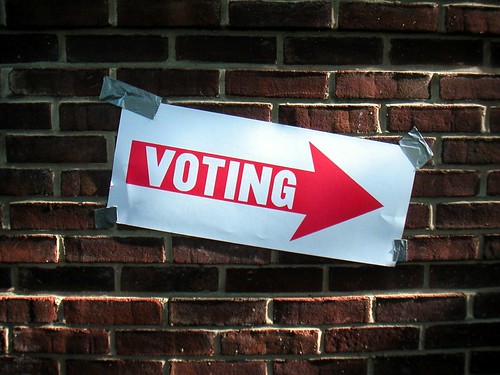
We meet a couple in advanced middle age. M. greets them warmly. These are his son's parents-in-law. The man is a Muslim communist atheist, and his wife is Croatian. Their daughter was baptized as a young girl. The priest came to them and administered the baptism at their home. "He sometimes asks me," M. says, "if I would permit an imam to come into my home to take my son away." We see more and more election posters (a "well-informed source" has told me that the voting will be postponed). The election posters are being crowded out by other ones: giant signs reading "U2" every ten or twenty meters. The concert is to take place a week after the elections.
"What's going to happen here?" I ask.
"No one knows. It all depends on the Americans."
"And what will happen when they leave?"
"War, certainly."
We say goodbye cordially.
Sarajevo, September 7, 1997.
back